What Do You Call That? – Field Notes No. 1
When you don’t get it because you’re not supposed to yet, and neither should they

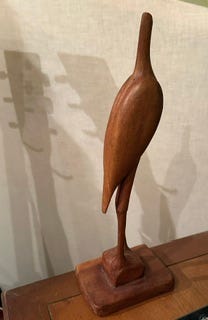
Bird in Space (after Brancusi) — noun. A form so reduced it becomes essence rather than likeness; what remains when everything representational is stripped away.
There’s a thin piece of carved wood on a shelf in my friend Brad’s attic. No head, no wings, no feathers, just a single curved line of warm, weathered wood, standing upright on its small base. I hadn’t noticed it before, probably because it’s tucked away on a corner cabinet in a space I don’t spend much time in.
Catching a glimpse of it out of the corner of my eye, I moved closer. Not too unlike Brancusi and his Bird in Space, I thought. I’ve had Brancusi on the brain of late, so naturally I see him and his art everywhere.
Turns out the sculpture in Brad’s studio wasn’t stylized. It was actually broken, with its head snapped clean off years ago, and no one has bothered to fix it. It simply sits there, unmended and unapologetic, needing no permission to still count as art.
It got me thinking about Constantin Brancusi’s actual Bird in Space sculpture (smooth, abstract, headless by design), which was the subject of a famous legal fight in the 1920’s over whether abstract shapes are art. Without any distinguishable bird features like feathers, wings or a beak, his art didn’t look like a “real-world object.” US customs taxed the sculpture as “kitchen utensils or hospital supplies,” lacking a better category to place it in. Brancusi disagreed, arguing that the abstract can convey beauty and feeling as powerfully and legitimately as traditional representational statues. His work depicted the essence of flight, the feeling of rising, not the literal bird. He sued and won, forever changing how US law views modern art. His case is the reason abstract art has legal standing in this country today.
How curious the space between the new thing rising, the making and the naming. Between something becoming, and what to call it. And how we hold this space, before we understand the fullness of the expression still taking shape. How could we have words to describe what we can’t fully identify or name ourselves? This doesn’t make it any less real, or impactful, or legitimate. We don’t need a box, a model, or a category to already exist before we trust the thing rising in us, whether it’s the new habit, the unfamiliar or resurfacing longing, the new version of ourselves taking shape. The absence of a name isn’t proof of absence. The inability of someone else to get it, or understand why or what we’re doing doesn’t negate its value or legitimacy. We might not even understand it ourselves, so how can we expect others to? Sometimes it’s just proof that we’re on to something, early. There’s that thought again: What if you’re not late…but early?
This is familiar territory for me. I’ve spent a long time writing about grief that has no name, no ritual, no sanctioned box to grieve in. Turns out the same is true on the other side of loss: the things being born in us don’t wait for a category either.
Many of us have our own shelves of half-formed things right now. For me, its songs, essays, ideas on post-it notes, a book I’m writing that doesn’t fit neatly into a genre. A version of myself I can feel rising before I can describe her. None of it looks finished. Some of it, if I’m honest, looks broken, snapped clean off whatever I thought I was building toward, kept anyway because I like what remains.
Brancusi didn’t wait for customs to agree with him. He kept making his art and sharing it. He continued working in the direction of the shape he could feel, even without language, or universally acceptable words or definitions for it.
That’s what Field Notes is going to be, most weeks. Circling some strange, specific thing that gives me the feels until it hands back a shape I didn’t have a name for yet. Right on time.
This week, it was a broken bird on a shelf.
What about you…
Is there something rising in you right now that you haven’t quite found words for? You don’t have to name it — just notice it.
Have you ever quietly decided you were too late, or too behind, when really — you might just be early? What would it feel like to believe that instead?
Is there a part of you waiting for someone else’s blessing before you’ll believe your own work counts? What if it already does?
Until next week…