Just One Good Idea
On scarcity, abundance, and the dream that needs a room to become real — The Wayback Machine, No. 2

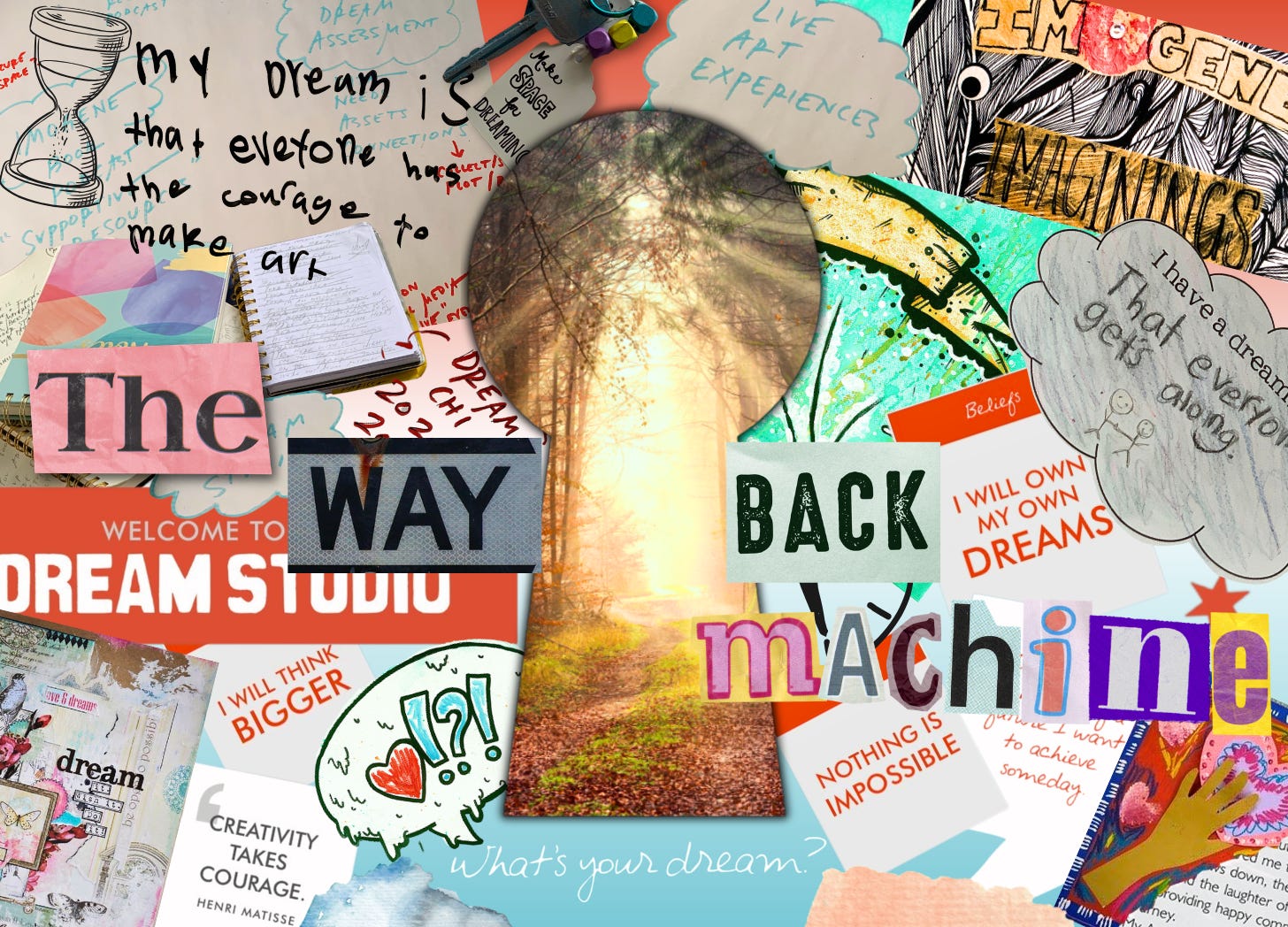
It was a First Saturdays morning at our Fulton Street studio. This month, the theme was Dream Filmmaking. The room was full of excited dreamers, adults at various ages and stages, some who had always wanted to write films, others already working on them, beginners and more advanced writers sitting side by side. Our instructor that morning was an award-winning screenplay writer based in LA and Chicago, generous enough to bring his expertise into our studio and offer it to a room full of people with a dream but no next step.
We had reached the moment to shift into workshop mode, prompting our speaker to turn to someone in the room and ask if she’d like to share her idea.
Without pause, she said, “No, I wouldn’t.”
The room grew quiet as we all looked up from our notebooks. None of us expected that reply. At first, I thought she was joking, but then she made it clear she was dead serious.
She continued, “I don’t want anyone stealing my idea from me.”
The room went silent. We were all happily scribbling and sitting with our own ideas and dreams, and weren’t sure what to make of her fear being named so plainly. And implicating us! I remember thinking: wow, her idea must be pretty amazing, which was followed immediately by a less generous internal reaction: we all came here with our own ideas. Nobody wants yours.
But that thought, true as it was, missed the point entirely. Because her fear wasn’t really about a stolen dream or her distrust of us. It was about something deeper going on inside her.
She was boldly naming the fear that creativity is finite, that you only get so much, that sharing means losing, and it’s a competition with everyone and yourself. But this was the exact mindset Dream Chicago was built to challenge. We had just asked a room full of people to write 100 dreams. Not ten. Not twenty five. A hundred. Because abundance is a practice, a mindset, and not a given. And here was someone sitting inside that room, still hiding inside the scarcity. Someone I knew well and yet had no idea what she was struggling with.
I marveled. What if she was the whole reason we were here today?
I recognized something in her fear that revealed more than concern about a stolen plot. What if she shared her story and the room decided it wasn’t good? What if it was her only creative offering and it wasn’t enough? That combination of scarcity and self-doubt was something I knew intimately. Not about a film idea, but about something else I’d been protecting. The worry wasn’t really that someone else would take it. It was that sharing it might confirm what she already feared about herself. That sharing it doesn’t just risk the idea. It risks the whole story we’ve been telling ourselves about who we are and what we’re capable of.
And what about stolen ideas? There’s an argument to be made that all artists steal. T.S. Eliot put it plainly: “Immature poets imitate; mature poets steal; bad poets deface what they take, and good poets make it into something better, or at least something different.” Austin Kleon built an entire book around that idea, called Steal Like an Artist. The creative tradition has never been about pure originality. It’s about what you do with what you’ve inherited and encounter, what you take in and transform and release back into the wild as something new, with your fingerprints all over it.
Which means the years that look like waiting aren’t wasted. When I worried it was too late to pursue songwriting, a friend reminded me I wasn’t starting from scratch, from nothing. I was actually starting from decades of experience and education and inspiration. She began recounting an exhaustive list: every song I’d ever listened to, every mix tape I’d ever made and received, every journal entry and paper I’d written, every concert, every piano lesson, every joy encountered and heartbreak I’d survived, every grief I’d carried and set down. It had all been underground, turning slowly into something that could grow. Everything was still there, composting in the dark, becoming something richer than I knew, waiting for the moment I finally sat down at the piano or the page and said yes.
Whenever we show up and say yes, whether we’re 22 or 42, we aren’t arriving at a creative life empty. This seems obvious, but most of us don’t live that way. We spend so much time worrying we don’t have enough that we forget to count what we already do. What we carry in our back pocket. We treat creativity as something we have to earn, accumulate, prove. As if the years before we “officially” said yes didn’t count. We arrive full of everything we’ve ever lived and loved and seen and shared. The question is whether we trust what’s inside.
Which means she wasn’t protecting one idea. She was sitting on a gold mine-–a lifetime of possibility and potential and creative wealth she hadn’t identified as her own.
Our facilitator was undaunted by her response. He moved a bit closer to her, smiling with kindness and understanding. He didn’t dismiss the fear or argue with it. He simply offered a reframe. You say “your idea” as if it’s your only one. But you are capable of so many. Don’t worry about protecting this one, because even if someone did steal it today, which won’t happen, you have multitudes more where that came from.
And then he talked about how any movie we watch in a theatre has passed through dozens of hands before it ever reaches us on a big screen. There are editors, directors, producers, actors, cinematographers, each one shaping and refining and building on what was already there. He talked about “killing your darlings,” the writer’s term for the willingness to let go of the lines, scenes, or ideas you love most, because sometimes what you’re most attached to is exactly what’s standing in the way of the work becoming what it needs to be. He reminded us that even the most celebrated filmmakers in the world share their ideas with teams of people, trusting them with the vision, letting them help bring it to life. Because they know collaboration allows us to do more than we can do alone. It gives us access to all the insight and expertise and creative possibility that no single person can hold. It was a good reminder that all dreams are realized in community. No dream has ever been achieved in isolation, without support from others.
The idea doesn’t diminish by being shared. Or become any less yours. It becomes fuller, richer, stronger. It grows.
She wasn’t immediately convinced. She sat with his words for a while, listening as others enthusiastically shared their ideas, their plots, their characters, the arcs of stories they’d been carrying around inside them, sometimes for decades. And the room did what Dream Chicago rooms do best, meeting each “do you think there’s something here?” with an enthusiastic yes, offering unanimous encouragement to keep going, only you can do this, we want to hear more.
Nobody stole anything. No one criticized or critiqued. Everyone was generous with their support, treating each idea presented to the room with the respect and honor the sacred moment of sharing deserved.
And slowly, her face softened.
She raised her hand.
Would it be ok if I share mine after all?
What happened next was a trademark of those First Saturdays, when someone finally let the dream be seen. The room acknowledged, thanked and affirmed the dreamer behind the idea. They told her it was good. They told her only she could do it justice. They told her to keep writing.
We all watched as her internal shift manifested outward. It was evident in her relaxed smile, her open posture. The realization arrived not as information, but as felt truth: her fear of someone stealing her idea had been rooted in a deeper fear that she actually wasn’t very creative at all. That there was a scarcity of good ideas, and she was only capable of one. That her well was shallow. That if she shared the one good thing she hoped to make, there might be nothing left.
But the well ran deep. Deeper than she could have imagined prior to that moment.
What she discovered that morning, what our insightful facilitator gave her, and what the generous room confirmed, was something Dream Chicago was built to nurture. We do not realize dreams alone. Not a film. Not a song. Not an arts organization. Not a life. Sometimes this gets lost in the solitary nature of making — the many hours alone at a piano, a page, a canvas or screen, composting in the dark before anything is ready to surface. The long labor that happens in private, before anyone else sees or hears the product of the making. It can feel like the work belongs only to you in those hours. And it does. But only for a season. Because ultimately, the dream needs more space to breathe and become what it’s meant to be.
She came in believing she was protecting her one idea from the room. She left understanding that the room was the only way the dream could ever become real, more than a figment of her imagination. And that there was so much more where that came from. That’s why Dream Chicago existed, created not as a place to keep your dreams safe, but as a place to finally let them be seen.
Today, I miss that space. But here’s what I’ve learned about dreams: they don’t disappear when the room does. They wait. Patient as stone. Constant as morning. Ready for the next invitation.
—-
You there…
What have you been protecting so carefully it can’t breathe?
What if the years that felt fallow were actually preparing you?
What if the well runs deeper than you think?